Huntington's Disease Patient- retains smooth movement Jeffrey was 37 and has had Huntington's disease* for 14 years. He is a very intelligent man and has his master's degree. In February of 2008 he participated in a session of MnemeTherapy at an adult day care center. Pre-session, his arms jerked uncontrollably and it was difficult for him to write or feed himself. After the session, he was able to move his arms freely without jerking and walk much better. This video clip (above) is after his second session, one month later in March 08. He said he was now walking two miles a day, was able to use the computer and play chess. *Huntington's disease is an inherited condition characterized by abnormal body movements, dementia, and psychiatric problems. For more information: Huntington's Disease Society of America. www.hdsa.org |
Although the goal of MnemeTherapy™ is to provide a rewarding experience, documented testimonies show significant improvement in some clients after just one session in:
Click here to read our documented testimonies or about the amazing changes in our autistic students What is MnemeTherapy? MnemeTherapy™uses everyday pleasures such singing, movement, painting and story telling in a unique combination to stimulate dramatic changes in the brain. MT is not a cure, nor is it a psychological process like art therapy. Read more about Directed Painting™ |

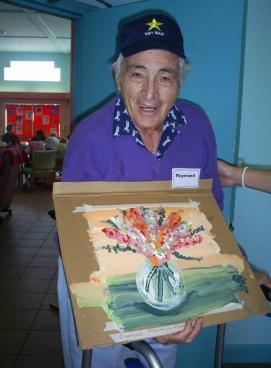
| AWB strives to protect the privacy of our clients. Photos and first names have been used with permission |
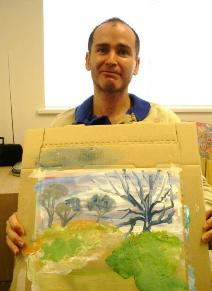
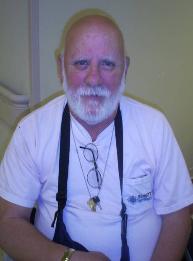
"Since my stroke, I've seen everything upside down. (a condition known as Inverted Vision) It was difficult trying to make things out and it affected my balance. Since I participated in a session of MnemeTherapy in February, I've started seeing everything right side up and it's stayed that way." -Ken, Atlantis Health care, Lantana, Florida Below you can hear an interview in April, 2008, with Founder, Noell Hammer talking to Ken about what happened during his first session of MnemeTherapy™ |
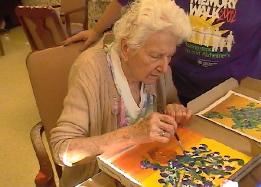
October 2003 "Miss Mary" Aiken, SC Reporting: RN, Director of Programming "Mary was diagnosed with Alzheimer's disease. Before painting with the MnemeTherapist, she was angry and depressed. She seldom came out of her room, did not interact with other residents, did not participate in activities, did not eat well." "After her first session of MnemeTherapy™ Mary seemed to wake up. She started to come out of her room for most of the day, interact with other residents, eat better, gain weight, take more interest in activities and had an insatiable desire to color and paint. This lasted until her death (nearly a year later)." |
Person Reporting: Program Nurse "A former business man, our patient spent all of his time sitting alone at one of the tables, briefcase open, shuffling papers around. He was demanding of the staff, continually asking for a meeting with them. He had very little interaction with the other patients and didn't willingly participate in activities.
group, sat down in the circle of chairs and participated in a game. Since that time and until his death, Irving willingly participated in group activities, visited with other patients and ceased "working" alone at the table. He was more content and smiled more often." |

| "Started to Participate in Activities" |
"On Location" by Irving, one
of the producers of the first
four James Bond films
of the producers of the first
four James Bond films
| "More Aware of Surroundings" "No Longer Combative" |
| . |
Inverted Vision Corrected |
Person Reporting: Director of Adult Day Health care Our patient was unresponsive and generally spoke in disjointed one word sentences. The best way to describe her was 'disconnected.' She did not make eye-contact or appear to recognize faces. She was apprehensive and had poor spatial acuity, often bumping into things in her path. She could not follow, or understand verbal instructions and did not participate in activities. At the end of the session, she was actually smiling, singing and dancing. She made eye contact and appeared to recognize faces. She was able to follow a complex set of instructions. She smiled and interacted with her peer group during "presentation" (of her work). The next day she recognized me from across the room and came over, maneuvering around a table and wanted to dance. At the end of our dance she said, "I danced myself out of my shoes!" Everyone has seen a huge difference in her. She is speaking in complete sentences with appropriate comments and seems much happier and more aware of her surroundings." |
Person Reporting: Manager "Our patient did not respond to verbal requests such as stand up, sit down, take this. We had to feed her and assist with toileting. It generally took two aides to help with toileting, as she would become frightened and fight the person trying to help. It took some time to get her to stand up and come to the painting table. She had to be physically cued and the same was true when it came to painting, she didn't reach for the brush and Noell had to work with her for a time to even hold the brush." "At the end of the session, we were amazed when asked once, she quickly got out of her chair without any physical cueing. She was very pleased with her painting, but the real surprise came when the aide took her to the restroom, she cooperated completely, even assisting with her own clothes. The aide kept crying, 'it's a miracle!' At snack time we were further amazed when she fed herself." |
| From our File |
Verbal skills increased Reported by wife: Male patient in Adult Day Center (ADC). Prior to session, patient had visited numerous doctors and speech therapists with the same diagnosis: he will never speak again. After one MT session he was able to count to 10 and tell his wife he loved her. Documented by Activity Director, female stroke victim (ADC). Prior to session, patient responded verbally to all questions with "yes." Post session patient could clearly say her name and "I want you." Documented by Administrator, (ADC) Male stroke victim did not speak prior to session. Post session he could say "I love you" and his wife's name. He also showed a change of expression, which he didn't before. Documented by RN (ADC) Male patient was unable to answer questions. His answers were vague and rambling. He was unable to count past two. After session he could answer questions such as where he was born and his wife's name. He was easily able to count to 10. He showed much more expression in his face and made direct eye contact Documented by Activity Director- (ADC) Male patient speech was disorganized and rambling. He could not respond to a question. After session he could respond correctly to questions about his life and his wife's name. Mobility Increased, stiffness decreased Documented by Activity Director in ADC Prior to session patient took very slow, shuffling steps. It took a long time to get him anywhere. After the session, he walked with longer strides, picking up his feet and moving much more quickly. He also seemed to stand up much straighter. He was very pleased by this. Documented by Activity Director in Nursing facility Prior to session, Male patient moved very slowly with a walker. He drug his feet and inched along. After the session he moved much more quickly and took longer strides, picking up his feet more. Documented by Administrator, ADC Male patient diagnosed with Lewy Body Disease was very rigid. Arms and legs did not bend easily, arms were drawn up to his chest and he was twisted to the side. His speech was garbled. After a 30 minute session he had full range of movement in arms and legs and said a complete, clear sentence to his wife. Documented by Administrator, ADC Male stroke victim's arm had little mobility and jerked violently when he tried to extend or used it. After session, he was able to extend it fully and move it smoothly without jerking. He also regained use of his hand. Spatial acuity increased Documented by Manager, ADC When patient began session, she seemed disconnected to her environment. There was no eye contact, she did not respond to verbal instructions or visual stimuli and did not show any type of emotion on her face. After one 30 minute session, she responded correctly to verbal instruction, made eye contact, was able to find and grasp something presented to her, seemed to enjoy the painting experience, showed expression on her face and even comprehended and laughed at a joke. Documented by RN (ADC) Male patient who received spoon feeding was do anything for himself. He was unable to communicate or respond to instructions. After session, he could respond to instructions, grasp the brush when presented, respond verbally and sing. Combativeness decreased "Something's happening here: Dementia patients make connections through art" Reporter: Jennifer Jones, Anderson Independent-Mail, Anderson SC February 25, 2006 Angela Childers, a resident care tech at Riverside Living Center, usually had a difficult time with one of the residents. The woman was very combative, hitting and biting those trying to dress her or bathe her. After a session with Ms. Hammer, however, something in the woman seemed to change. "I thought she was a different patient. It was like night and day. She’s had a wonderful, wonderful day. I wouldn’t have believed it had I not seen it," Ms. Childers said. "She’s happy and she’s told me she loves me, I’ll bet six times today." Carla Heritage, executive director of the Riverside Living Center, said there are no words to describe the differences she’s seen in the residents. "I just wish everyone could see this. The families are just amazed." she said. |
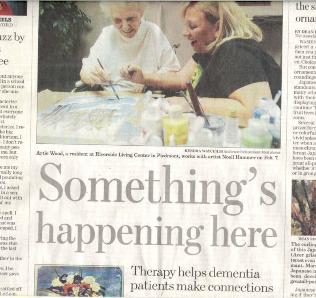
Read the whole article by clicking here
| Young client helped after one session |
 |  |  |  |  |  |  |  |
The Art Without Boundaries Association has tax exempt status under Section 501(c)(3) of the Internal Revenue Code TM 2005 Art Without Boundaries™ and MnemeTherapy™ are both trademarks with all rights reserved. You may not copy or reproduce anything from this website without written permission from AWBF Art Without Boundaries Association, Inc. Contact Webmaster |
 | |  | |  | |  | |  | |  | |  | |  | |  |
| Documented Testimonials |
This video is of a health care professional after viewing one thirty minute session of MnemeTherapy with a patient who was non-verbal and very confused. |
The Art Without Boundaries Association

Dr. Joe, a former chiropractor received brain damage as a result of his time in
the service. This led to expressive aphasia, (couldn't communicate) receptive
aphasia (couldn't understand words) and visual agnosia (brain not interpreting
information from the eyes.) After the first session of MnemeTherapy, he began
to speak in sentences and through continued sessions, was able to understand
words and eventually to begin to see again
the service. This led to expressive aphasia, (couldn't communicate) receptive
aphasia (couldn't understand words) and visual agnosia (brain not interpreting
information from the eyes.) After the first session of MnemeTherapy, he began
to speak in sentences and through continued sessions, was able to understand
words and eventually to begin to see again
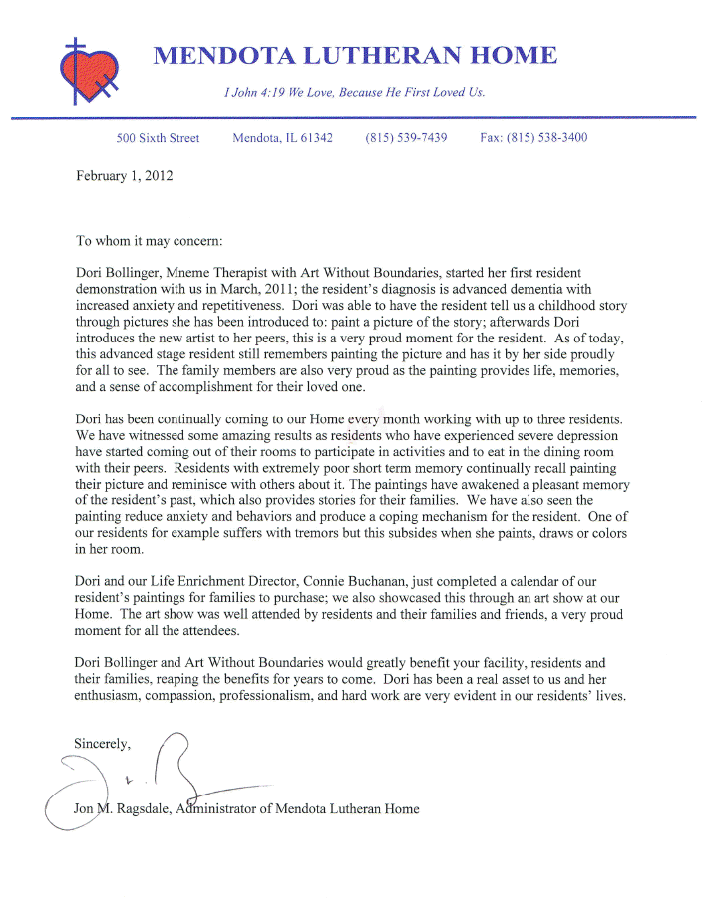
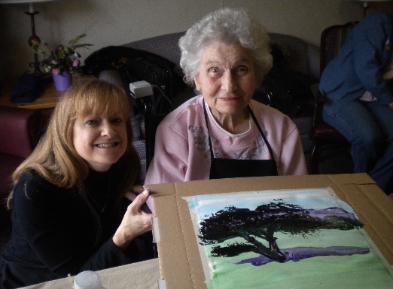
| Visit our member's video page for more testimonials |


Barbara worked with 23 of our residents last Fall on their art pieces. I selected the newest residents at that time and those who I thought would enjoy something totally different and who did not usually participate in other activities within the community.
was impressed with her gentle demeaner with each of them. She was very patient as she directed their work and her voice was gentle and not commanding. She knew how to move them along to the goal for that half hour together. During their time of working, I could see true joy and time of fun happening. As they progressed, the mood changed from "I can't draw or paint" to "I can't believe I did that". As I have spoken with them about the project since or as I was giving them their finished work, they have recalled with a smile their experience of the process. Several used the paintings as Christmas presents. Unfortunately some of them do not have the cognitive memory any more to remember their specific time together, but they smile as they are amazed that they "painted that beautiful picture". I particularly enjoyed watching the wife of one of the residents be overjoyed at seeing him create a painting, a brand new experience for him personally. They BOTH experienced a completely fun time together.
the experience and felt a little more part of the larger community, which can be overwhelming as they made so many changes in their lives to move to The Windsor. We will be having Barbara come to work with more of our residents this summer. I am looking for our newest residents to be part of this wonderful experience. Thank you to Barbara for connecting with me to provide such an opportunity at The Windsor. Lylln Brinkman Activities Director |
| Dori Bolllinger-Thompson |